AI voice agent development

Voice agents that take orders, answer customers and book appointments.

A voice agent is only useful if it finishes the job: understands the request, checks live data, handles changes, confirms, and writes the result into your system.

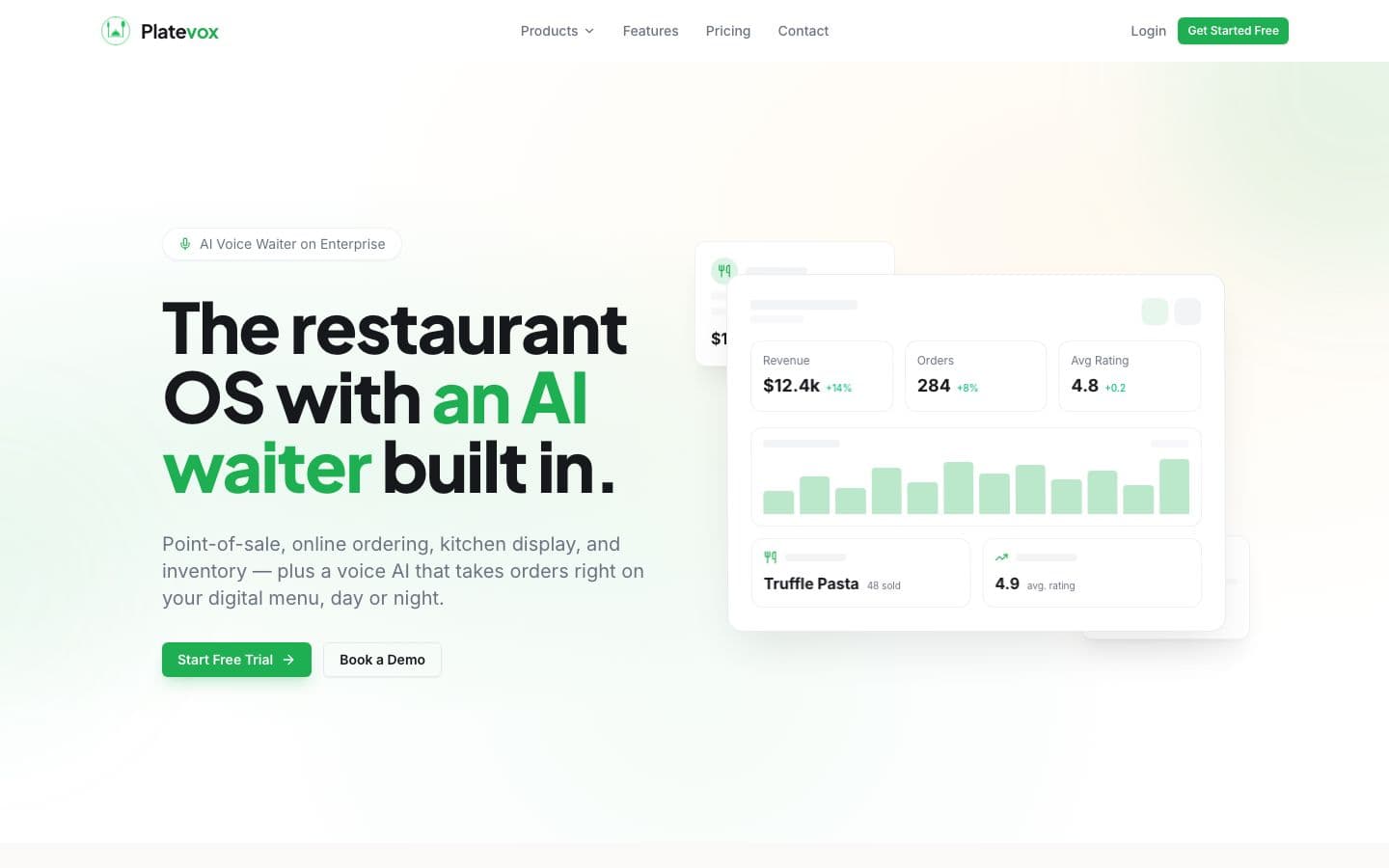
I built that end to end as founder and lead engineer of Platevox, where an AI Voice Waiter takes restaurant orders on the digital menu in natural conversation and sends them straight to the kitchen display. I build the same kind of agent for other businesses.

Fixed-scope package

Custom AI Voice Agent

From $6,000

3–5 weeks

  • Conversation design for one use case (ordering, support, booking or lead qualification)
  • Speech-to-text, LLM reasoning and text-to-speech pipeline
  • Integration with your live data and one target system
  • Web or phone channel (Twilio)
  • Call logs, transcripts and a handoff path to a human

Final price depends on scope and is fixed in writing before work starts.

Is this for you?

  • Staff can't answer every call or take every order at peak times.
  • Customers call outside business hours and you lose the lead.
  • An off-the-shelf voice bot can't read your live menu, catalogue or calendar.
  • You want voice in your own product, not a separate third-party tool.

What I build

Voice ordering agents

Agents that read your live menu or catalogue, handle modifications and special requests, confirm the order and push it into your order system, as the Platevox AI Voice Waiter does.

Support and booking agents

Agents that answer common questions, qualify leads and book appointments against your real calendar, with a clean handoff to a person when needed.

Web and phone channels

In-browser voice on your site or app with no extra hardware, or phone lines through Twilio. Built on voice platforms such as Vapi and ElevenLabs or a custom pipeline, depending on latency and cost needs.

Bring-your-own model

Model routing through OpenRouter so you can use your own account and switch models without redeploying, the same approach Platevox offers its customers.

Proof: products I've built

How it works

  1. 1. Use case

    We pick one high-value conversation and define what a successful call looks like.

  2. 2. Conversation design

    Prompts, tools and fallback paths, tested against real example requests.

  3. 3. Integration

    The agent is connected to your live data and writes results into your system.

  4. 4. Pilot

    A limited rollout, transcript review and tuning before full launch.

Tools and technologies

Voice AITwilioVapiElevenLabsOpenRouterOpenAI GPTClaudeWhatsApp APINext.jsNode.js

Frequently asked questions

How much does a custom AI voice agent cost?
A voice agent for one use case, such as ordering, booking or support, starts at $6,000 and typically takes 3–5 weeks including integration with your live data. Ongoing model and telephony usage is billed by the providers to your own accounts.
Have you built a voice agent that runs in production?
Yes. I am the founder and lead engineer of Platevox, a restaurant operating system whose AI Voice Waiter takes orders on the digital menu in natural conversation, handles modifications, confirms the order and sends it to the kitchen display.
Does a voice agent need special hardware or phone lines?
No. A web voice agent runs in the customer's browser on your site, QR menu or app. Phone numbers are optional and are added through Twilio when you want customers to call in.
What happens when the agent doesn't understand?
Every agent is built with fallback paths: it asks a clarifying question, offers the on-screen option, or hands the conversation to a person with the transcript attached.

Ready to talk about your project?

Book a free 30-minute call. You'll leave with a clear recommendation, whether or not we work together.

Book a free 30-min call